
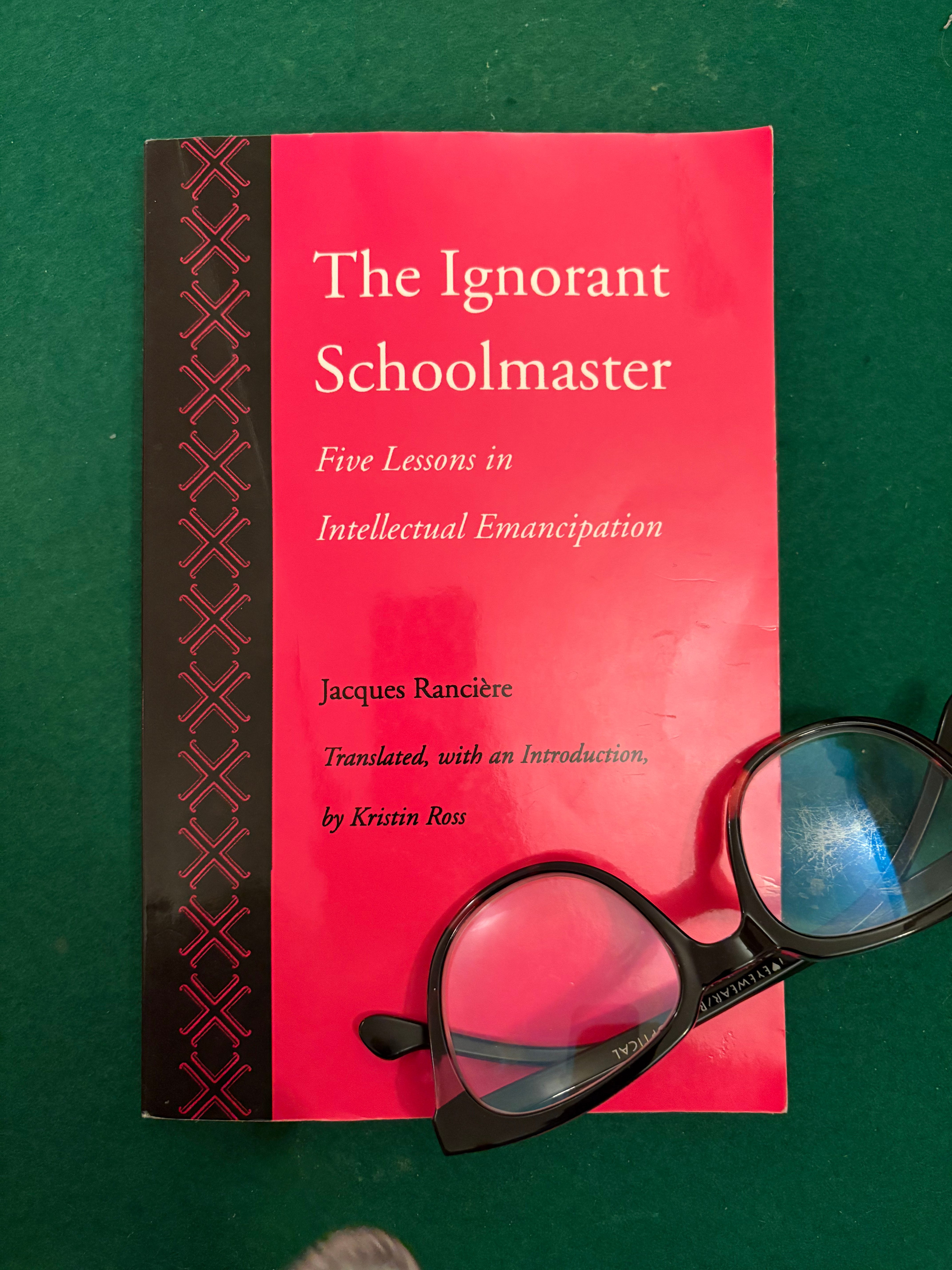
The Ignorant Schoolmaster: Five Lessons in Intellectual Emancipation by Jacques Rancière
Reading notes

translated by Kristin Ross
Stanford University Press
1991
Several friends in academic places - have suggested I read The Ignorant School Master by Jacques Rancière (read it for free at the Internet Archive). The idea of reading another French scholar intimidated me, which isn’t surprising after my MA program dropped me in the deep end on Michel Foucault and figured everyone would have context.
Well - I finally picked it up and the first 15 pages were so interesting I decided to write about it. Hopefully the first in an intermittent series where you watch me explore ideas like they are foreign countries
.
Chapter 1. An Intellectual Adventure
Introductory chapter tells the story of imaginary lecturer Joseph Jacotot whose Flemish students teach themselves to read and write French, causing him to reconsider the role of the teacher and education in relation to intelligence and power.
The old view of teaching is that the teacher (master) can “recognize the distance between the taught material and the person being instructed, the distance also between learning and understanding” (5). Traditionally, the teacher has a set end point for the student - learning objectives. They assess the student’s abilities at the beginning of the teaching period to ascertain how much teaching and practice will be necessary to close the gap between what the student knows and what the student must know in order to achieve the stated end point. Part of assessing the student includes assessing the student’s abilities - which we call intelligence. The master is a guide through territory unknown to the student and his methods will depend on the student’s intelligence
When Joseph Jacotot’s students teach themselves French without guidance from a master, they prove that a master is not necessary for learning. Upon reflection, Jacotot sees that learning without a teacher happens all the time, that it’s how children learn, and that it’s a great equalizer. If everyone can learn, then no one is a master. Instead, there is equality. “The method of equality was above all a method of will” (12) he writes, because the learning comes from application to the work of learning, the project and reward of learning as opposed to closing a gap. Learning - one could argue - happens at the edge of an abyss because there is no end to the things that a person doesn’t know.
The Emancipatory Master
Introducing definitions here; stultification whereby “[I]n the act of teaching and learning there are two wills and two intelligences” (13) and emancipation which is “the act of an intelligence obeying only itself even while the will obeys another will” (13). Which differentiates between curiosity or learning and society or an external will. The revelation here is that learning can have a direction without having an aim.
This section also differentiates between teaching and knowledge, suggesting that knowing a thing (subject) is not the same as being able to teach a thing - or not the primary qualification for teaching a thing. Expecting all knowledgeable people to teach is like expecting navigators to know how to fix the plane engine. It’s not their job.
This brings him to a proposal, which is that “nothing prevented the master from teaching something other than his science, something he didn’t know.” (14) In other words, a teacher doesn’t have to know material in order to help a student learn that material. There’s an opportunity here to give the student more agency in the theory - or to recognize the student’s agency in the act of learning. Another way to put it is that teaching and learning are not necessarily related. In fact, they can be fully disconnected.
This leads to Jacotot teaching classes in which he starts by announcing, “’I must teach you that I have nothing to teach you’” (15). Those words are so similar to my own introductions that it’s difficult to remember what I used to say. It was something like “I have nothing to teach you.” Like Jacotot, I was “experimenting, precisely, with the gap between accreditation and act” (15). And in reality, it’s an experiment that continues for me today. I’m living a life where my accreditations are unimpressive while I believe the things I can do and have done (my actions) are impressive. My interactions with other people happen somewhere in the gap between what I can do and what they believe I know.
The Circle of Power
At the core of all this is the fact that traditional (stultifying) approaches to teaching rely on a belief that the teacher knows more than the student that knowledge is a source of power. Perhaps the real power is in deciding what does and does not constitute knowledge, in delineating what a person should know in order to say they are knowledgeable about a subject. The methods of teaching that take place in a classroom or education system depend on disbursing knowledge from one source through a system of mediators to multiple sources. It’s a dissemination program, not an education program. Break the knowledge down into parts and then decide who gets access to what and which privileges that knowledge will grant you. Rancière calls this the circle of the powerless (15) and it is governed by secret mechanisms.
His proposed alternative depends on all the mechanisms of learning being exposed, shared, public. In it, “[T]he ignorant person will learn by himself what the m aster doesn’t know if the master believes he can and obliges him to realize his capacity” (15). In other words, the student can out-learn the teacher. This is an additional layer to the concept of emancipatory teaching in that the learner no longer depends on the teacher. Instead, they DIY their own learning.
Here, I think of the Mulla Nasrudin and his sermon. Nasrudin is a character from Sufi folklore who is the wise man and the fool. In “The Sermon of Nasrudin,” villagers try to make a fool of him by asking him to give a sermon in the mosque. He starts his sermon with a question, “O, people! Do you know what I am going to tell you?” Read the story in The Exploits of Nasrudin by Idries Shah, available online for free.
Rancière proposes to call this DIY learning “universal teaching” (16). His terminology reminds me of Noam Chomsky’s universal grammar as described by Steven Pinker in his 1994 book, The Language Instinct. Pinker examines how how children learn languages and explores the strangeness of the fact that we are almost all able to learn our first language without having anything like a formal training in the language. Universal grammar and universal teaching share a lack of barriers. There is no ticket for entry, there are no rules, and each individual is encouraged to find their own way through the process. empowering, indeed.
Resisting this approach to learning is to focus on one’s power instead of a student’s learning. As he digs into the differences here, a difference emerges between instruction and educate. The old model where a teacher transfers knowledge is instruction. The new model where a student can take control of their own learning is more like education - the method matters more than the outcome.
The conclusion is that “Whoever teaches without emancipation stultifies. And whoever emancipates doesn’t have to worry about what the emancipated person learns” (18). This conclusion eliminates the teachers traditional role as the one who sets learning goals in terms of material or understanding and knows more than the student. Instead, the teacher’s guide is to cut the student free and not lead, but perhaps follow where they go.